An analysis of salary limit vs performance, Segunda Division, 2017-2022

This post has nothing to do (directly) with CD Castellón. I wrote it before I started this blog, more out of curiosity than anything as a stats geek. That said, as Castellón itself is also subject to the same rules, and is fighting to get into the Segunda Division, I thought it could still be interesting for Castellón fans to read about other teams’ performances, and for those not so familiar with Spanish football to get an idea of the financial pressures involved. Hope you find it useful!
1. What is the salary limit and the challenges of the Spanish football system
Instituted by Javier Tebas as he took over the reins of LaLiga back in 2013, the idea behind the salary limit (or ‘limite salarial’) is to ‘guarantee the financial stability of clubs’ in Spain. While it is debatable if this has actually benefitted or hampered clubs in practice (especially in the international market), it is calculated (in a nutshell) using the difference between the income and the costs of running the club. Income is considered to be anything from ticket sales to TV rights and marketing, expenditure is any money spent on everything from players, wages (and health insurance), and infrastructure to any non-playing employees of the club.
This presents Spanish clubs with an arguably even stricter challenge than merely complying with UEFA’s Financial Fair Play, and has caused serious difficulties for a number of clubs, from most notably Barcelona, all the way down to Reus (in more serious debt), who were eventually suspended and liquidated.
While Barcelona has the luxury of being able to sell off future TV rights in order to spend even more money on the likes of Lewandowski and Koundé, the vast majority of smaller La Liga and Segunda Division clubs walk the financial tightrope every year and must (especially since 2013) often do less with more.
Similarly to the Championship, clubs relegated to the Segunda Division have a season of being allowed a much bigger budget for the league, but those unable to immediately regain promotion often face significant issues. In recent years, we have seen historically large clubs (Deportivo in particular) fall from great heights due to financial mismanagement and poor on field performance, and being left in the third tier with a challenge to regain their status.
All of which is to say that clubs that are able to find consistent success on a small budget given the particular constraints of the top Spanish divisions are worth investigating further. Of particular interest is unearthing models which are not manager dependent. There have been many examples of clubs who secure promotion off the back of a great managerial performance, only to lose the progress once the manager moves on.
This analysis aims to highlight a couple of outliers, who from my research have defied their salary limits through their league position over the past five years and their performances on the pitch.
2. The data, 2017-2022
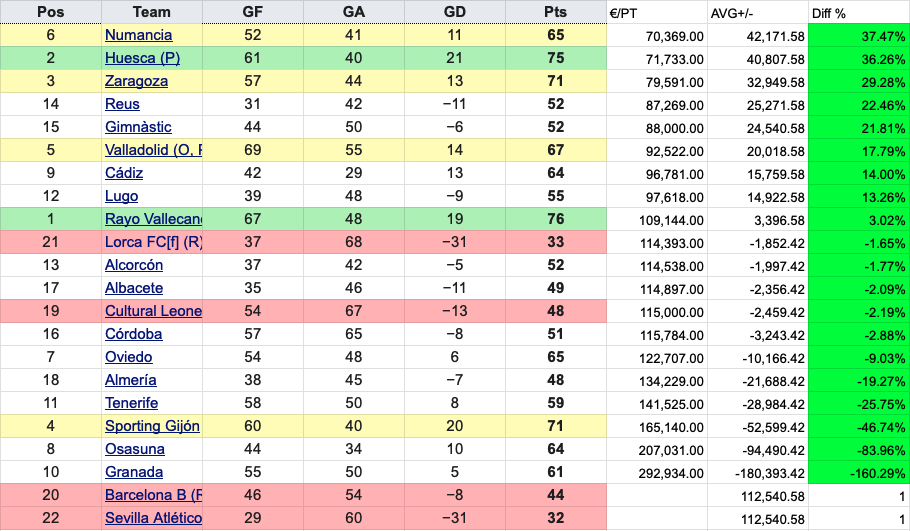
I compared the league position in each of the last five years to the salary limit for each club. The data for the latter is released each year by LaLiga for both the summer and winter transfer windows. There are occasionally differences between the two time points, but often nothing significant, especially in the Segunda Division.
Once one has obtained a ‘cost per point’, it is easy to then calculate the average of the league, and measure team performance relative to the average for that season. This is highlighted in green. The full table for each of the last five seasons can be found below. The Google Sheets version is available here.
2017/2018
2018/2019
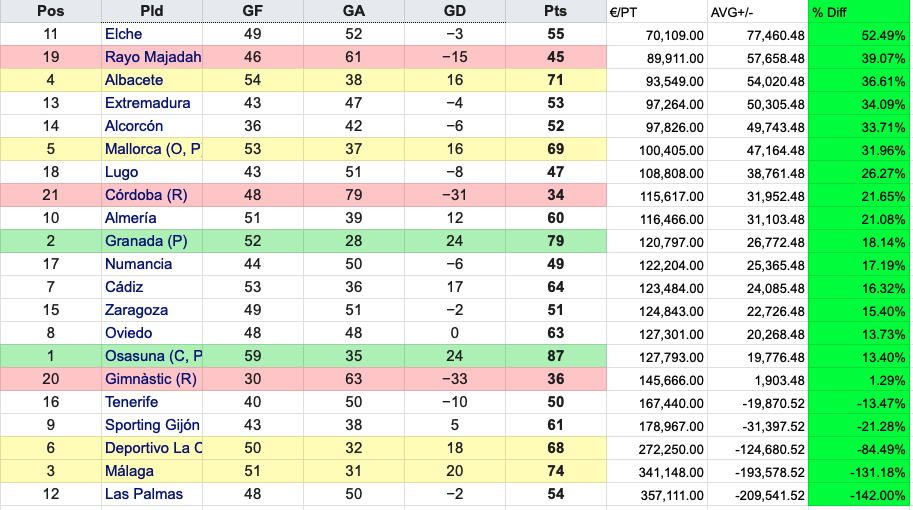
2019/2020
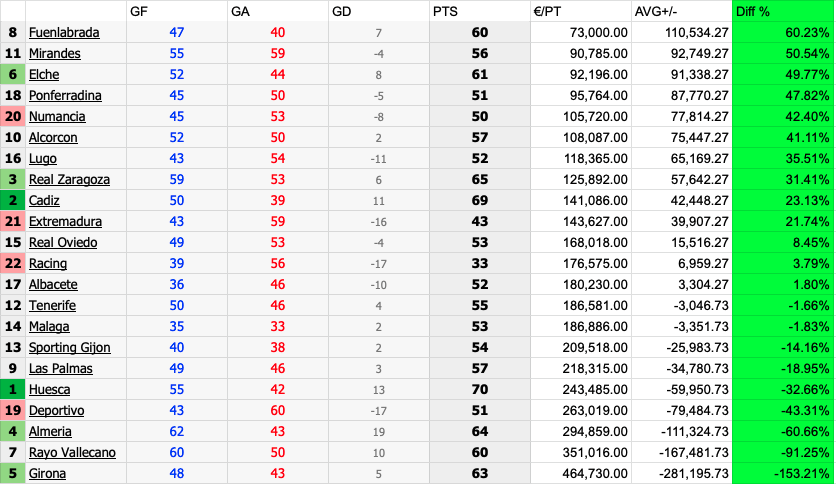
2020/2021
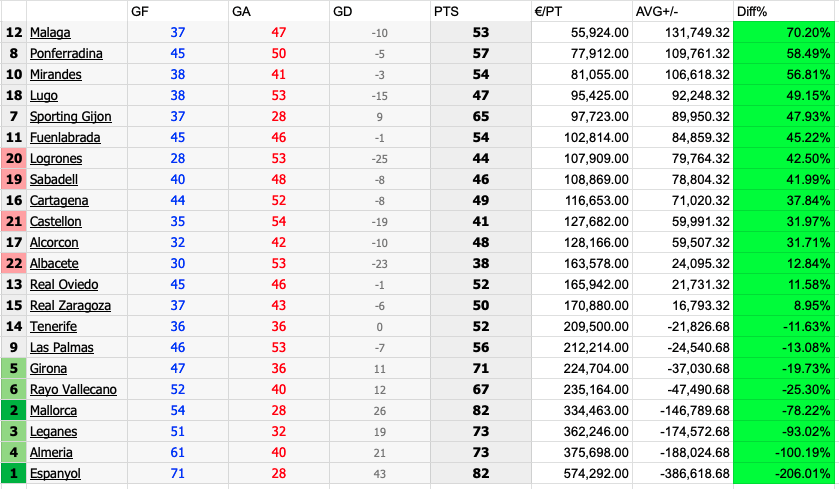
2021/2022
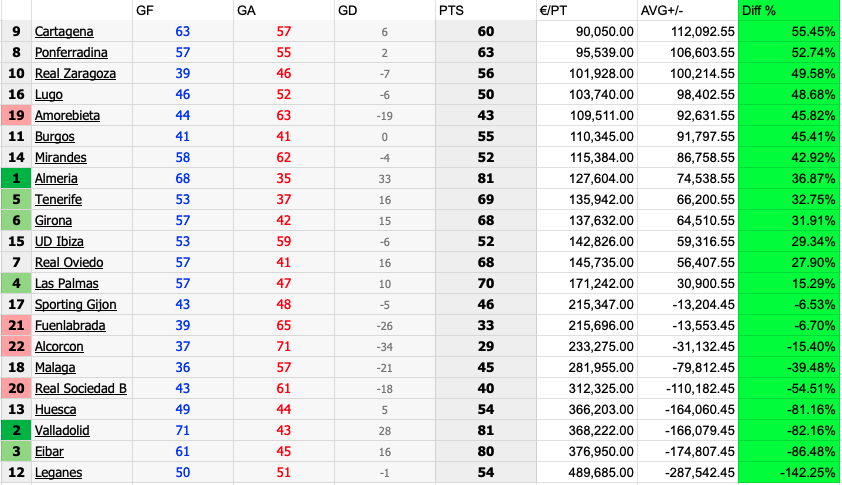
Before diving deeper into the two outliers below, let’s consider some honorable mentions, and some of the “catastrophic” seasons over the last five years.
Granada - 2017/2018
The title of worst performance over the last five seasons goes to Granada in 2017/2018, who by finishing 10th spent 160% more than the average cost per point. Although it was rectified the following season as they achieved promotion at a much more healthy 18% under the league average, it could have been a lot worse.
Espanyol - 2020/2021
With a huge salary limit of 47 million (almost double the next team), there was no other choice but promotion for the Catalan side. It was a huge risk, but clearly paid off, as they were able to consolidate last year in LaLiga.
SD Ponferradina
Although consistently ranking in the top 3-5 every year since their return to the Segunda Division in 2019, the question is what will happen this season, following the departure of their manager Bolo to Real Oviedo. His spell at Ponferradina corresponds exactly with their return to form, and without a doubt he should be commended for the performances he has consistently been able to get out of his Ponferradina side over the past three seasons. If Ponferradina maintain a similar position in 2022-2023, they should be reconsidered for ‘outlier’ status.
Fuenlabrada - 2019/2020
Fuenlabrada hold the record for single best season relative to their salary limit, with a cost per point that was a remarkable 60% cheaper than the league average (Málaga technically did better in 2021, but their financial situation is/was extremely complicated, so it’s unclear to what extent it can be taken at face value). Unfortunately this severely tailed off until being relegated last season, but Mere (the manager who got them promoted back in 2019) has returned and will be hoping he can repeat the trick.
3. Outlier #1 - CD Lugo - A model of consistency
My personal favorite of the two outliers. Although results might not seem spectacular, the very fact that Lugo has maintained its status in the Segunda Division is as impressive as any title or promotion won by any team over the past five years. In only one season of the last five (2019/2020) has Lugo had a salary limit of over 6 million euros. And despite that, the club has avoided relegation not just for the last five years, but for the last ten.
2022-2023 will be its 11th season in the same division, and while the more ambitious might be getting restless, it has been a massive overperformance relative to the means of the club. Out of the last five seasons, Lugo finished in the top 5 of difference relative to the average cost per point twice, never falling lower than eighth in any given season. Their best performance was 49% less than the average, and their worst 13%. Once again, an impressively small range. Even if one opens the comparison up across other European leagues, it stands out just as much.
In addition, it is interesting that even though the manager who set them off on this path to stability, Quique Setien (more recently of Barcelona), left in 2015, it has not had a devastating impact on the club’s fortunes. Indeed, including Hernán Perez, who was appointed in July 2022, the club has had 13 different managers. Not an ideal situation, but also perhaps a testament to the club that despite so many changes it has been able to stay afloat in the same division.
4. Outlier #2 - Elche CF
After dropping down to the Segunda B in 2017-2018, Elche went straight back up and never looked back. They finished 11th in 2019, and secured promotion to La Liga via the playoffs in 2020, completing a remarkable turnaround.
In doing so, they were the most efficient club in the cost per point table in 2019, and in the top 3 in 2020. Perhaps even more impressively, they stayed up against all odds in 2021, and finished mid-table last year, beating expectations once again.
All while not being manager dependent. In fact, Elche were relatively ruthless. Since Pacheta left after they got promotion to La Liga, they’ve have three managers and managed to improve from season to season.
Their results last season included draws against Real Madrid, Sevilla and Athletic, and wins over Betis, Villarreal and Celta. The most they spent on a single player was Raul Guti, who arrived for €5 million from Real Zaragoza in 2020, most of their arrivals being free transfers or loans.
Away from the stats and their performance on the pitch, Elche have had an interesting few years off it as well (for full details, checkk out this article). They were taken over by Argentine football super agent Christian Bragarnik while in the Segunda Division, and as a result have taken on a distinctively Argentine flavour. Their squad features six Argentine players including Javier Pastore, formerly of PSG.
Bragarnik, who has been referred to as the Argentine Jorge Mendes, has done a good job of using his considerable influence in South America to source players for Elche in a way that almost no one else could have. There has been some controversy over his connections to the underworld in Mexico, but given his extraordinary success with Elche, he has got fans excited for what the future holds. It seems Elche are also pushing for partnerships with other clubs, with Liverpool reportedly involved in discussions as of April this year.
5. Outlook for 2022/2023
I started writing this ahead of the 2022/2023 season. Now five games in at the time of writing, Lugo have established themselves firmly in mid-table, with two wins, one draw and two losses. In La Liga on the other hand, Elche have not got off the to best start. They lie 19th, with only one point collected so far.
On 9 September, La Liga published the salary limits for the upcoming season. Elche is rock bottom of the table. In other words, merely staying in La Liga would once again be an incredible achievement if they can pull it off. However it looks complicated, as teams around them get stronger and economic crises around the world set in.
Lugo also have the lowest salary limit in the Segunda Division for 2022/2023, and if they continue on the path to securing yet another mid table finish, it will continue an incredible run that they really have no right to be on.
I look forward to seeing how teams continue to evolve and manage the stringent financial regulations imposed on them by the RFEF, and which teams can perform well despite reduced means.