The macro and the micro
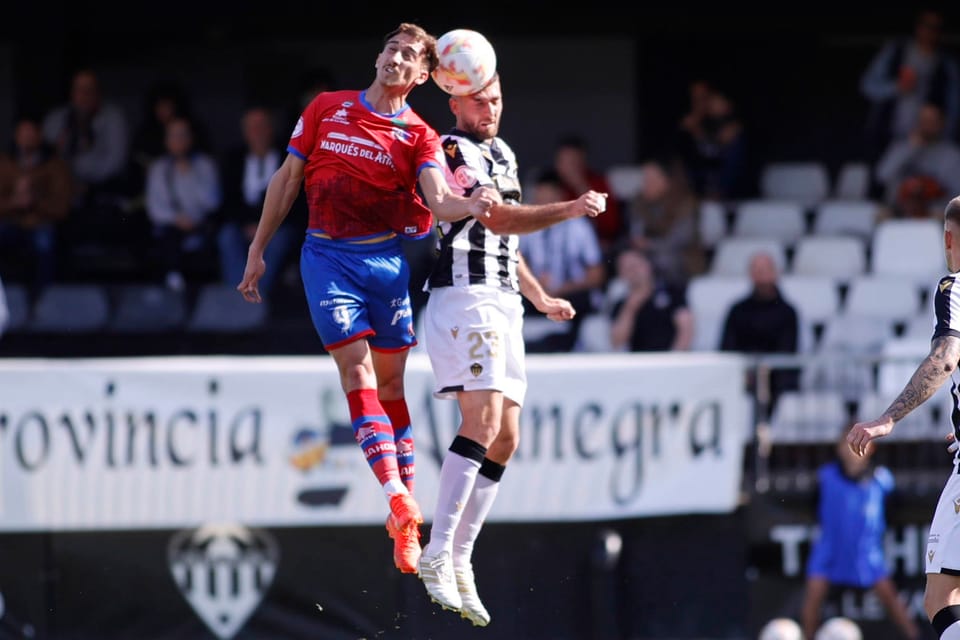
The macro and the micro, two things that, in football and in life, people often have round the wrong way. They put speed in the macro - they want everything quickly and now, and patience in the micro - they don’t execute day-to-day, and are happy to put things off. Instead, speed should be in the micro - fast, hard work day to day, and patience in the big picture. Luckily for Castellón fans, the club is being run by people doing the latter.
The micro
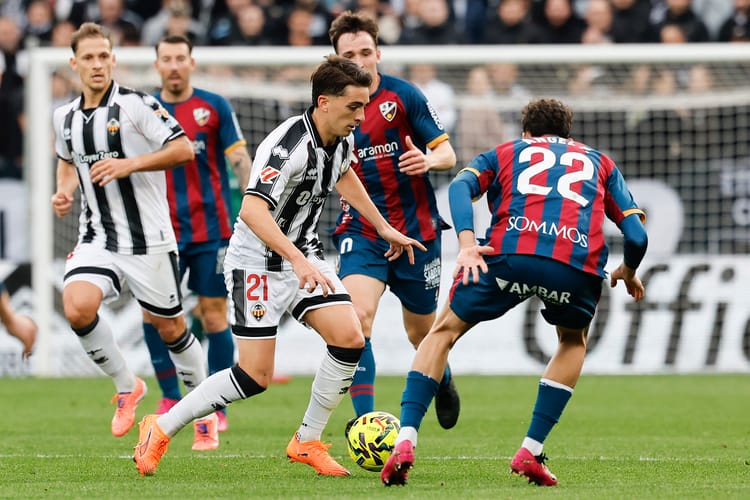
Castellón’s 1-2 loss against bottom side Calahorra was unexpected and infuriating. A missed opportunity to close the gap on leaders Eldense, who lost against Amorebieta, and a situation where one more loss could see the Albinegres fall out of the playoff positions. After winning their first game in a long time on the road against Logroñes, the momentum is once again broken and the team need to pick themselves up and go again.
The macro
When Castellón reached 50 points last year, there were two games left. They finished the season in 13th place, losing 5-0 to Barcelona B and 3-1 Cornellà in the last two games of the season. This year, they reached that mark with eight games left to play.
Compared to last summer, the club now has: a training ground, a full squad, committed sponsors, a six year plan, financial stability, flights to long distance away games, a head of recruitment, a head of ticketing, multiple analysts and I’m probably forgetting stuff.
Since Bob Voulgaris took over the club, the macro has never been bad, it’s been excellent. In fact, it’s got better and better. The micro, on the other hand, has clearly varied. Winning streaks, losing streaks, strong at home, weak away. We are currently at the lowest point of the Rudé era, and we’ll see where it goes next. There are three factors, from my point of view, that have contributed to the problems in the micro.
1. Implementing positional football
Positional football is what many of the world’s best clubs aspire to, and it’s clearly Albert Rudé’s goal as well. And while the end result often produces a sumptuous brand of attacking football, the process to get there most often isn’t easy - in reality it’s often a multi-year process.
Whether it’s Mikel Arteta’s early struggles at Arsenal, or Graham Potter’s struggles at Chelsea, it’s easy to find examples of implementation problems, even with the highest-level squads in the world. It’s often not something players are used to, or have much experience of, but once they get, they get it. Brighton replaced Potter with De Zerbi, a manager cut from a similar cloth, and achieved perfect continuity. The challenge, clearly, is building and developing a squad over time that becomes comfortable with the ideas, enabling them to execute on the pitch. Arteta was given the time to do it, Potter not so much.
If it’s difficult at Premier League level, as you drop down a few divisions to CD Castellón, Albert Rudé has his work cut out, albeit the the support of one of the most professional setups in the Primera RFEF. When the decision was made to sack Rubén Torrecilla in December, it was also a move to rip the band-aid off and get started with implementing the long-term philosophy in earnest.
This will take time, and although in the micro there will be some difficult spells, everyone on the sporting side of the club is convinced it is the way to go long term. It has never been at done at this level in the way they are doing it, we will have to see if it becomes second nature to the players, whether it’s this season or the next.
2. Injuries
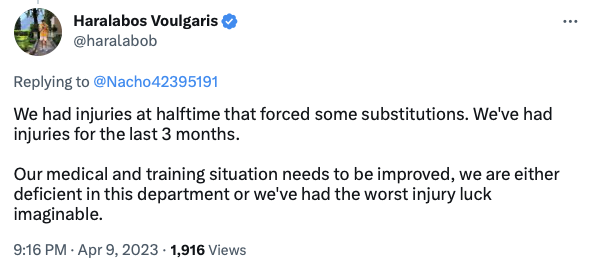
Castellón signed five players in January. Adri Fuentes has played 32% of the minutes he’s been available for. De Miguel, 20%. Roland Baas, 38%. Borja Granero, 59%. Isra Suero, 70%. The latter is the only player who was always available for selection, between injuries, fitness, availability issues. And that’s not to mention the likes of Javi Anton, who has just been sidelined with a knee issue after missing a couple of games already.
Whether it’s extremely bad luck or an improvement the club needs to make at the physio/medical level, it’s difficult to gain any benefit from signings when they have availability numbers like the ones above.
3. Questions for Rudé
It’s difficult to criticise from the outside, without having access to the full picture and data that the coaching staff has. There may well be perfectly good answers to these questions, but these are the things I can’t figure out from the outside looking in, and the things I haven’t heard asked in interviews/press conferences over the last few weeks.
Is Castellón still doing the positional thing?/What is the role of David Cubillas?
Until the game against Gimnastic, David Cubillas had played 3% of available minutes. In the last three games, he has started all of them and played 65% of available minutes. Why the drastic change, and above all, why do it against Nastic?
Let’s talk about the profile of the Castellón captain for a second: physical, strong in the air, a good outlet for clearances and holding up the ball. A real target man, with much less focus on the technical side, and more of a facilitator than a goalscorer.
Castellón played back-to-back away from home on two of the worst pitches in the division against Intercity and Amorebieta. They lost both games, and Cubillas played one minute out of 180. Of all the conditions the number nine could have excelled in, I have to believe it would be on pitches where playing to feet was impossible. The decision to suddenly bring him into the team on the Wimbledon-like pitch at Castalia is confusing, but could indicate a (temporary) switch away from the positional philosophy Rudé so embraces.
What will be fascinating to see is what happens with the return of De Miguel, a similarly tall, but more technical option. He was already on the bench against Calahorra, and he should logically return to the starting XI at some point, presumably at the expense of Cubillas.
As final point, I’ve always been confused about those who embrace positional technical, football, but also place huge value on set pieces. It may be possible to do both exceptionally well, but it does seem that what will give you an advantage in one area will take away from the other. Playing someone like Cubillas means much more of a threat from set pieces, but implies a different way of playing in open play. Conversely, playing someone like Fabricio/Suero as the main striker would give a lot more dynamism, tactical flexibility and options in transition, but take away from the aerial presence in the box for set pieces. In the game against Calahorra, given the opponent was not overly physical and playing in favourable conditions, starting with Cubillas again raised some questions for me.
How does Castellón improve their composure defensively, especially when being pressed? Or simply improve their clearances in general?
One common theme in the way opponents have played Castellón over the last few weeks has been the use of (high) pressing, which has consistently given the Albinegres a lot of problems. This concerns both the ability to make the right decisions under pressure, but also to find good clearances that allow the team to move up the pitch and occupy territory. Here are a couple of examples from the Calahorra game, although similar issues have been visible consistently for much of the season.
Example #1: The wrong pass
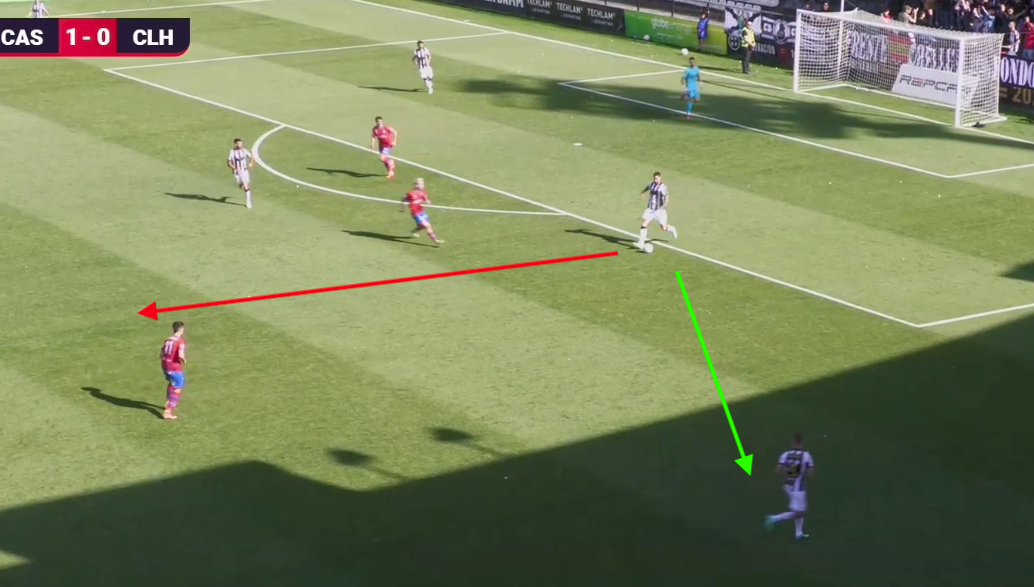
In the example above, in search of verticality, the pass is played directly forward, into the pressure from Calahorra. A pass out wide, to the full back, would have been preferable here, and given Castellón additional space, potentially to move forward on the wing. Instead the ball is lost, and Castellón give away a free kick in their own half.
Example #2: Poor clearances
In this case, it’s actually much more difficult for Castellón than in the example above. Calahorra do a great job restricting options. The striker comes over to cut off the option of going back to the keeper, and the pass to the full back is also covered by another player. The decision to go long is the right one, but it’s cleared towards the middle of the pitch, where the Calahorra midfielders do a good job of creating a two-on-one situation on the intended recipient. They win the ball in the middle of the park as opposed to deeper in their own territory. Clearing it down the wing into space, where it was a one on one situation with De Leon would have been preferable. Not necessarily in terms of keeping the ball, but in terms of being able to gain territory and push forward. Castellón do ultimately win the ball back in the middle of the park due to a mistake by Calahorra, but the problem with the initial clearance remains.
But credit where it’s due…
I can’t criticise the inability to deal with pressing without mentioning that Castellón’s winning goal against Logroñes resulted directly from the Albinegres taking advantage of poor pressing and the team from Rioja playing with such a high line. So on that note, if Castellón can find a way to consistently deal with it well and punish teams who attempt to play that way, it should dissuade others from trying.
Back to 4-4-2?
Arguably the last time Rudé started with two strikers was in the 2-0 win against Eldense back in February, with De Miguel and Adri Fuentes playing more centrally, and Raul Sánchez and Suero on the wings. In practice it was a super flexible 4-4-2, as De Miguel often dropped a bit deeper, Suero played inside, and there was relatively frequent position switching. Given the success of that system, perhaps it would good to go back to that, subject to player availability. For all the personnel changes in the starting XI, the formation has stayed consistent over the last few games.
A front duo of De Miguel/Cubillas-De Leon seems intriguing to me, especially given the Puerto Rican has shown he can finish well and take chances. Even in defeat against Calahorra, De Leon was arguably Castellón’s best player, with his dynamism and constant movement on display. If you complement that with someone in a target man role, it would give Castellón some great options to either play long or go down the wings and destabilise the opponent horizontally to create an overload (as the team has done many times already this season successfully).
There are seven games left to play, seven finals. Four away, three at home. Three against direct competition for the top five (Barça B, Real Murcia and Real Sociedad B). The micro, as detailed above, is challenging and difficult. However 21 points are on the table, and the objective now has to be to go for all 21. There is no room for conservative play anymore.
Although the chants of Rudé out were ringing out around Castalia after the game on Saturday, the Catalan is staying, and will be given the chance to figure things out. To fall out of the playoffs completely would be disastrous considering where the team was in November, but perspectives are important. There would perhaps be less pressure from the fans had it been a slower start to the season (mid-table around Christmas), and a stronger finish. The micro dynamic clearly needs to change whatever happens, but I would argue the macro outlook is still incredibly positive as ever, and patience, especially in this case, will be rewarded.