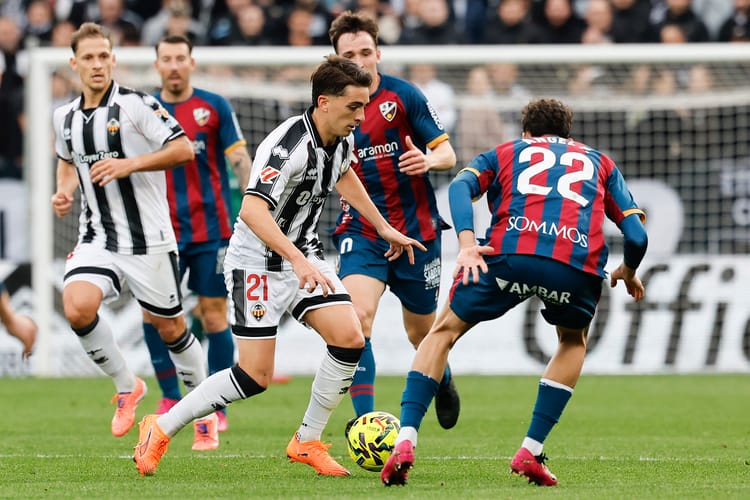
The secrets to Castellón's success (Part 1 - Where)

🇪🇸 En Español más abajo
While Castellón's offense and goals might be the sexy centerpieces of the team's incredible run, it's actually the defence under Pablo Hernández and set-pieces that have underpinned the performances. This is the first of a series of articles, and here we will look at where the success has come from.
Ahead of the trip to Las Palmas on Saturday night, it is now four wins from the last five for Castellón, including eight consecutive wins at home, after 2-0 triumph over Deportivo La Coruña. When one takes a deeper dive behind the results, the reasons for Castellón's dominance emerge, and beyond the offensive prowess, there are several key differences under Pablo Hernández that are new for Castellón in the Bob Voulgaris era.
Wins-to-nil
The first rather basic indicator is the number of wins-to-nil we have seen since Pablo's appointment. There have been six of them so far, out of 14 total wins in the Hernández era. 43% might not seem like a lot, but compared to the 28% last year, it's a already a noticeable improvement, and the season isn't even close to being finished yet.
Goals scored/conceded relative to other teams
Another eye-opening, and surprising statistic, is that while Castellón does have the third-most goals scored this season, behind Almeria and Racing, it has the joint second-best defence, with only 25 goals conceded. Relatively speaking, Castellón's defence has actually outperformed its offense this year in terms of production, which is completely mindblowing when you consider last season, and the five games before Hernández took over. Last year, Castellón had the third-worst defence in the league, with 63 goals conceded for the season. While Castellón this year are definitely better (1.69 goals per game vs 1.54 last year), the real improvement has been at the other end of the pitch.
Set-pieces
Smart data teams all have set-pieces at the top of their list as far as the top areas to gain an advantage, and Castellón are no different. That said, this has been the season where the results on the pitch have started to match the time and effort put in behind the scenes. Rody Hoegee was hired full time in the summer as the in house set-piece specialist, after the team had worked with a set-piece consultant on a freelance basis last season. On the pitch, players were also brought in specifically with set pieces in mind - midfielder Ronaldo Pompeu, centre-back Fabrizio Brignani and striker Adam Jakobsen being the standout recruits for corners and free kicks.
Castellón lead the league in set-piece goals with 16 so far this year, which is about 0.6 per game, far more than last season's 0.3 (stats from Xavi Sidro's article). Castellón are the also quite comfortably the team that obtains the most corners in the league, thus being able to generate more set-piece opportunities than any other team as well. All of that means than Castellón generate 26% of their goals from set-pieces, higher than normal in Spanish football.
There's been defensive improvement too, with only seven goals conceded from set-pieces, the lowest number in the division.
All the of the above results in a very different Castellón side than the one lead by Dick Schreuder. There are certainly common threads that will never change under Vouglaris - playing attacking football, never settling for draws, the extreme focus on recovering possession after losing it (Castellón leads the league here too). However Hernández's Castellón is more about composure and control, and being adaptable to the opponent's weaknesses. There isn't a set starting XI, and unlike the back three often used last season, there is now a consistent back four, with Mellot on the right and Lucas on the left as traditional full backs. All of which gets more into the "how", which we will cover next time.
Los secretos del éxito de Castellón (Parte 1 - Dónde)
Aunque el ataque y los goles de Castellón pueden ser los aspectos más sexy de la increíble racha del equipo, en realidad son la defensa de Pablo Hernández y las jugadas a balón parado las que han sustentado el rendimiento del equipo. Este es el primero de una serie de artículos, y aquí analizaremos de dónde proviene el éxito.
Antes del viaje a Las Palmas, el Castellón suma cuatro victorias en los últimos cinco partidos, incluidas ocho victorias consecutivas en casa, tras imponerse por 2-0 al Deportivo de La Coruña. Cuando se analiza más a fondo los resultados, se aprecian las razones del dominio del Castellón y, más allá de su poderío ofensivo, hay varias diferencias clave bajo la dirección de Pablo Hernández que son nuevas para el Castellón en la era de Bob Voulgaris.
Victorias sin encajar goles
El primer indicador, bastante básico, es el número de victorias sin encajar goles que hemos visto desde la llegada de Pablo. Hasta ahora han sido seis, de un total de 14 victorias en la era Hernández. El 43 % puede no parecer mucho, pero en comparación con el 28 % del año pasado, ya es una mejora notable, y la temporada aún no ha terminado ni mucho menos.
Goles marcados/encajados en comparación con otros equipos
Otra estadística reveladora y sorprendente es que, aunque el Castellón es el tercer equipo que más goles ha marcado esta temporada, por detrás del Almería y el Racing, tiene la segunda mejor defensa, con solo 25 goles encajados. En términos relativos, la defensa del Castellón ha superado a su ataque este año en cuanto a producción, lo que es totalmente alucinante si se tiene en cuenta la temporada pasada y los cinco partidos anteriores a la llegada de Hernández. El año pasado, el Castellón tuvo la tercera peor defensa de la liga, con 63 goles encajados en toda la temporada. Aunque el Castellón de este año es sin duda mejor (1,69 goles por partido frente a 1,54 el año pasado), la verdadera mejora se ha producido en el otro extremo del campo.
Jugadas a balón parado
Todos los equipos de datos inteligentes tienen las jugadas a balón parado en lo más alto de su lista en cuanto a las áreas principales en las que obtener ventaja, y el Castellón no es una excepción. Dicho esto, esta ha sido la temporada en la que los resultados en el campo han empezado a estar a la altura del tiempo y el esfuerzo dedicados entre bastidores. Rody Hoegee fue contratado a tiempo completo en verano como especialista interno en jugadas a balón parado, después de que el equipo hubiera trabajado con un asesor externo en esta materia la temporada pasada. En el campo, también se fichó a jugadores pensando específicamente en las jugadas a balón parado: el centrocampista Ronaldo Pompeu, el central Fabrizio Brignani y el delantero Adam Jakobsen son los fichajes más destacados para los córners y los tiros libres.
El Castellón lidera la liga en goles a balón parado con 16 en lo que va de año, lo que supone una media de 0,6 por partido, muy por encima del 0,3 de la temporada pasada (estadísticas del artículo de Xavi Sidro). El Castellón es también, con diferencia, el equipo que obtiene más saques de esquina de la liga, lo que le permite generar más oportunidades a balón parado que cualquier otro equipo. Todo ello significa que el Castellón genera el 26 % de sus goles a balón parado, una cifra superior a la habitual en el fútbol español.
También ha habido una mejora defensiva, con solo siete goles encajados a balón parado, el número más bajo de la división.
Todo lo anterior da como resultado un Castellón muy diferente al que dirigía Dick Schreuder. Sin duda, hay aspectos comunes que nunca cambiarán con Vouglaris: jugar al fútbol ofensivo, no conformarse nunca con los empates, la extrema concentración en recuperar la posesión tras perderla (el Castellón también lidera la liga en este aspecto). Sin embargo, el Castellón de Hernández se caracteriza más por la compostura y el control, y por su capacidad de adaptación a las debilidades del rival. No hay un once inicial fijo y, a diferencia de la defensa de tres que se utilizaba a menudo la temporada pasada, ahora hay una defensa de cuatro constante, con Mellot a la derecha y Lucas a la izquierda como laterales tradicionales. Todo ello nos lleva más al «cómo», que trataremos la próxima vez.